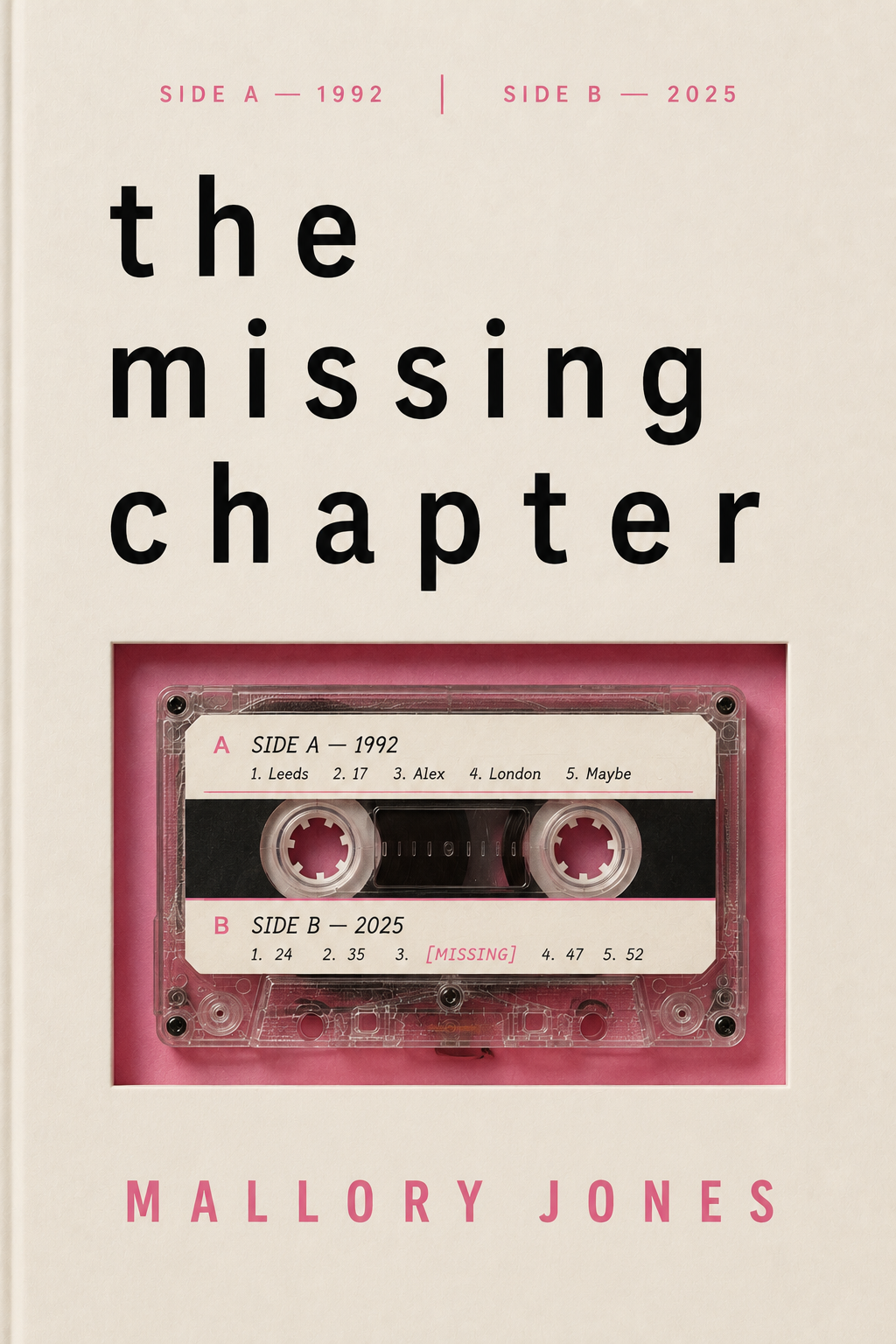
MALLORY JONES
The Missing Chapter
First love. Loud music. Teen pregnancy. Thirty years of unfinished business.
A novel about the people we were, the things we survived, and what happens when the past turns up again and says, “I loved you.”
About the Novel
Some stories don’t end. They just go quiet.
Freya and Alex were young, in love, and completely unequipped for what happened to them. Then life moved on.
Thirty years later, they reconnect.
The Missing Chapter moves between early-1990s Leeds and the present day — through first love, friendship, sex, pregnancy, trauma, loss, music, memory and all the things two people managed not to say to each other.
Until now.
Watch the Story
I’m reading The Missing Chapter from the beginning, one chapter — and occasionally one slightly chaotic recording — at a time.
You can watch everything here, in the right order, without having to persuade an algorithm that you’d quite like to see Part Two.
WATCH FROM CHAPTER ONE →
Come Behind the Scenes
I’m writing about the novel, sharing excerpts, talking about the music and memories behind it, and documenting what happens when you write a book and then have to work out what the hell you’re supposed to do with it.
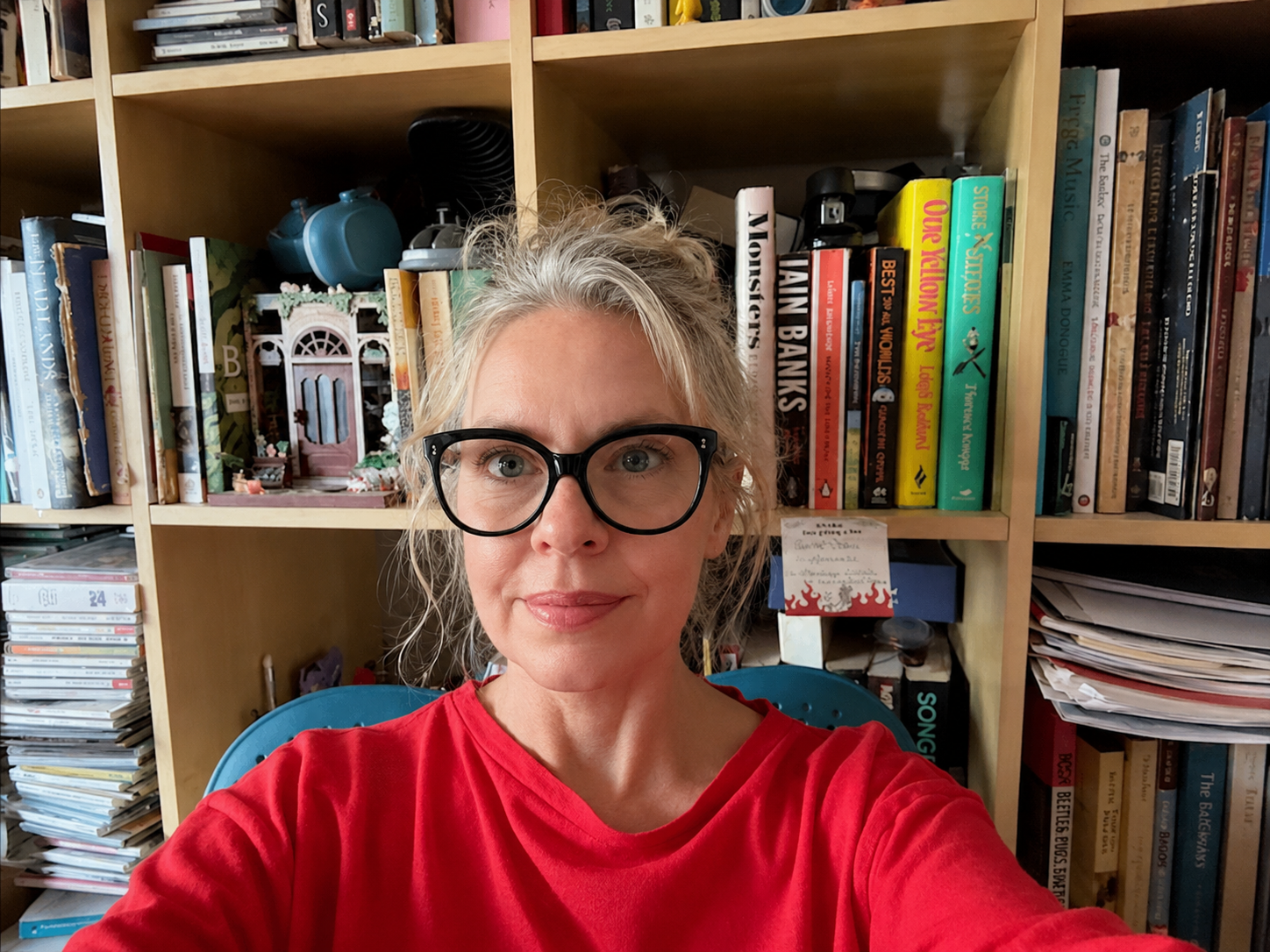
I Wrote a Novel in Two Weeks. Unfortunately, That Was the Easy Bit.
On noisy fictional people, unreliable memory, accidental BookTok, thirty-three years rearranging themselves, and discovering that apparently I am a novelist now.
There was no beautiful notebook.
No writing retreat.
No five-year plan involving character arcs, index cards and a tasteful shed at the bottom of the garden.
I received three words.
I loved you.
And apparently my response to this perfectly manageable piece of information was to write approximately 43,000 words in a week.
A week after that, I had around 78,000.
This is not normal behaviour.
Even I know that.
At some point during the second week, I looked at the thing on my laptop and realised, with some alarm, that it had acquired chapters.
There were characters.
There was structure.
There were recurring motifs.
There appeared to be a plot.
I had accidentally made a book.
And for approximately twelve minutes I thought:
Well. That was surprisingly easy.
Reader, it was not.
Writing the book took two weeks. Writing the book has taken considerably longer.
The thing that arrived in those first two weeks was the shape of The Missing Chapter.
And I remain slightly astonished by how complete that shape was.
It was almost as though the story had been sitting somewhere behind me for years, arms folded, tapping its foot, waiting for me to finally notice it.
Once I did, it came out at speed.
I wrote everywhere.
I wrote too late.
I wrote when I should have been doing other things.
I woke up knowing what came next.
I wrote scenes before I understood why they belonged there.
I wrote things and then thought:
Oh.
And occasionally:
Oh, fuck.
But there is an important distinction between having 78,000 words and having a novel.
The first requires a keyboard and an alarming degree of hyperfocus.
The second requires work.
So much fucking work.
Moving scenes.
Moving them back.
Deleting things.
Restoring things I had triumphantly deleted three days previously.
Discovering that a perfectly good paragraph was sitting in completely the wrong chapter.
Taking out explanatory sentences because the scene already did the work.
Putting one back because apparently the scene did not do quite as much work as I thought.
Realising that I had said the same thing three times.
Realising that I had said something important no times at all.
Checking dates.
Checking ages.
Checking whether something could actually have happened on a Thursday.
Developing opinions about em dashes that I did not know a human being could possess.
Writing fast gave me the shape.
Editing gave me the story.
And then there were the characters.
Nobody warned me that fictional people are such demanding bastards
This may be obvious to experienced novelists.
It was not obvious to me.
I thought I was in charge.
I had, after all, made these people up.
That seems, superficially at least, like quite a strong managerial position.
It isn’t.
Freya arrived first and immediately developed opinions.
Alex followed shortly afterwards and was considerably worse.
The problem with characters becoming properly alive is that they start objecting when you make them do things for the convenience of the plot.
You write a sentence.
Something in your head says:
He wouldn’t say that.
Excuse me?
I literally invented him.
Apparently irrelevant.
Delete.
Try again.
Or you decide a scene would be neater if Freya were slightly more reasonable.
Freya has absolutely no interest in being slightly more reasonable.
She is angry.
She’s funny.
She’s unfair sometimes.
She swears.
She notices things you’d rather she didn’t.
She refuses to deliver a tasteful piece of literary self-awareness simply because it would make the paragraph easier to finish.
And eventually I realised that this was a good sign.
The moment I stopped asking:
What do I need these characters to do?
and started asking:
What would these people actually do?
the book got better.
More inconvenient.
But better.
First-time-author lesson number one:
Apparently fictional people are very bossy.
Then memory started misbehaving
This would already have been an interesting problem in any novel.
It is particularly inconvenient when you have written a book in which memory is one of the central subjects.
Because while Freya and Alex were busy trying to work out what they remembered from thirty-three years earlier, I began investigating my own memories of the world that informs theirs.
Leeds.
The Phono.
The Duchess.
Record shops.
Bands.
Gigs.
Mixtapes.
The strange little alternative ecosystem we inhabited at the beginning of the 1990s.
And I discovered something irritating.
Memory is excellent at atmosphere and absolutely shit at administration.
I can remember the smell of a room.
I can remember what somebody’s hand felt like.
I can remember wet pavement, bus heaters and Doc Martens.
I can remember standing in a club with the bass somewhere behind my sternum.
Ask me which band played which venue on which Thursday in 1991?
Apparently my brain has filed that information under:
LOUD. LEEDS. PROBABLY BRILLIANT.
For decades I have confidently remembered Mudhoney as playing Leeds approximately every other Thursday.
The gig archives are rather less convinced.
Meanwhile, other bands keep appearing in the listings with suspicious regularity.
This has led to the deeply humbling experience of sitting at a computer in my fifties thinking:
Bloody hell. Alex and Freya aren’t the unreliable ones. I am.
Which is, of course, precisely what the novel is interested in.
Memory does not preserve a life like CCTV.
It preserves fragments.
Some are ridiculously clear.
Some are missing entirely.
Some have been quietly moved into the wrong folder.
And some can be returned to you decades later by another person who says:
Don’t you remember?
Sometimes you do.
Sometimes you don’t.
Sometimes the fact that they remember becomes more interesting than the memory itself.
One thing happened. Then fiction got involved.
This is the bit I find hardest to explain when people ask where The Missing Chapter came from.
Because the answer is both very simple and not simple at all.
The novel began with something real.
Three words.
Something from the past suddenly looked different.
That was the spark.
But a spark is not a novel.
Freya is not me.
Alex is not a transcription of another person.
The events of the novel belong to the novel.
Real experience gave me certain emotional questions.
Fiction gave me somewhere to take them.
What happens when the explanation you have carried for decades suddenly stops working?
What happens when two people remember the same relationship differently?
What happens when love and harm are both true?
What happens when somebody finally gives you the information you thought you had needed for thirty-three years — and then disappears before you can have the conversation that information creates?
And, perhaps most importantly:
What happens after?
That is where the book became more interesting to me than the event that triggered it.
I stopped trying to explain something that had happened.
I started following Freya.
That was the point at which it became a novel.
Meanwhile, my actual life apparently objected to being left out
All of this would have been quite enough.
Instead, while I was editing a novel about memory, first love, identity, silence and the stories we build our lives around, my own thirty-three-year relationship began rearranging itself.
Because apparently subtlety is not something the universe is particularly interested in.
There is a peculiar experience involved in editing a fictional woman’s understanding of her life while simultaneously looking around your own and thinking:
Well, this is awkward.
I don’t mean that the book caused anything.
Life is rarely that narratively convenient.
But writing has a nasty habit of making evasion slightly more difficult.
You spend hours asking a character:
But what do you actually want?
Then you close the laptop.
And unfortunately the question is still in the room.
You write about somebody recognising the difference between endurance and happiness.
Then you go and make a cup of tea.
The sentence follows you into the kitchen.
Very rude.
So while The Missing Chapter was being moved around on my screen — paragraphs shifting, chapters finding their correct places, things I thought were fixed becoming unfixed — something much larger was shifting outside it.
Thirty-three years is a lot of life.
You do not rearrange it neatly.
There are no chapter breaks.
Nobody inserts *** and moves you elegantly into the next scene.
Mostly there are boxes.
Administrative emails.
Moments when your house feels completely unfamiliar.
Moments when it suddenly feels like yours.
Grief arriving at deeply inconvenient times.
And the rather surreal experience of continuing to argue with fictional people while your own life is sitting behind you going:
Excuse me, I think you’ll find I have notes.
And then, for reasons I still don’t entirely understand, I joined TikTok
This may have been where things really got out of hand.
Having accidentally written a novel and then made the objectively questionable decision to send it to literary agents, I decided that what I obviously needed next was to learn social media.
At fifty-two.
From scratch.
Excellent.
I knew almost nothing about TikTok.
I knew slightly more about Instagram, which is to say I knew there were photographs.
Suddenly I was learning about vertical video.
Hooks.
Watch time.
Captions.
Static posts.
Reels.
Whether nine minutes is completely insane.
Where to put text so TikTok doesn’t put a button over it.
Why my face is enormous.
Why the sound is tiny.
Why the dogs apparently believe the phrase “Chapter One” means “begin barking immediately.”
There are teenagers running multinational personal brands from their bedrooms while doing their GCSEs.
Meanwhile I have spent forty-five minutes trying to work out why Instagram has cut the bottom off a picture.
Humbling.
And yet something quite lovely has happened.
People started watching.
Then some of them stayed.
Then they followed.
Then they commented.
They began talking about Freya and Alex as though they knew them.
Which is astonishing.
Because until very recently these people existed only in my head and in one increasingly alarming Word document.
Now somebody I’ve never met can say:
I don’t trust Alex.
And part of me immediately thinks:
No, no, wait. You don’t know him properly yet.
Which is ridiculous.
HE IS FICTIONAL.
See previous point regarding noisy characters.
I appear to have become an accidental novelist in public
This is possibly the strangest bit.
Writing is private.
Publishing — even tiny pieces of it on social media — emphatically is not.
Suddenly there are readers.
Actual readers.
People waiting for the next part.
People telling me which line got them.
People remembering their own first love.
Their own Leeds.
Their own gigs.
Their own box of tapes.
And that has changed something.
Not the book.
The book still has to be the book.
But my relationship with it.
For the first few weeks, The Missing Chapter felt like something I had extracted from myself at considerable speed and then needed to control.
Now it feels increasingly like a story.
Something separate.
Something Freya owns.
Something readers can meet without needing access to every private thing that might once have stood somewhere underneath it.
That separation matters.
Perhaps that is another thing fiction does.
It takes the unbearable specificity of one experience and makes enough room around it for somebody else to enter.
So this is where I am
I wrote the shape of a novel in two weeks.
I have spent considerably longer teaching it manners.
My characters remain uncooperative.
My memory is demonstrably unreliable.
I am investigating my adolescence with the assistance of internet gig archives.
I am learning TikTok at an age when I had assumed my principal technological challenge would be remembering increasingly complicated passwords.
I am discovering that people on Instagram are extraordinarily kind.
I am editing.
Rearranging.
Reading things aloud and discovering sentences that look perfectly acceptable on the page but apparently require three lungs to say.
My thirty-three-year relationship has ended, which is a sentence considerably shorter than the experience.
And somewhere in the middle of all of this, The Missing Chapter has stopped feeling like the strange thing that happened when I received three words.
It has become its own thing.
A novel.
About Freya.
About Alex.
About Leeds.
About first love and terrible communication and bodies and class and music and memory and what happens when we discover that the story we have been telling ourselves may not be the whole story.
I still don’t entirely know what possessed me to write it.
I certainly don’t know what possessed me to send it to agents.
And I definitely don’t know what possessed me to start reading it aloud on TikTok.
But I’m rather glad I did.
Because for all the editing and upheaval and sleeplessness and ridiculousness of the last few months, there are moments when I look at this strange little world that has appeared around the book and think:
Fuck me. I actually wrote a novel.
And then, usually, Freya starts complaining about a paragraph.
So I go back to work.
Mallory Jones
The Missing Chapter
More from The Missing Footnotes: writing, memory, Leeds, music, first love, and everything that didn’t quite fit between the chapters.